
Tests that come from what the system must do.
Test Generator turns acceptance criteria into proposed tests for your project language and framework. Each test references the criterion it is intended to validate and is ready for team review and execution.
- Unit, integration and automation
- Traceable to every criterion
- Your language and framework
- ZIP download
- Unit tests
- Integration tests
- Traced to criteria
Writing tests by hand is slow and always falls behind.
Test Generator turns expected behavior into concrete tests and links them to the source criterion, so you always know what each one covers.
Uneven coverage
The easy things get tested and the important business rules stay uncovered.
Tests without purpose
Nobody remembers which requirement each test validates.
Not enough time
Writing tests competes with delivering features.
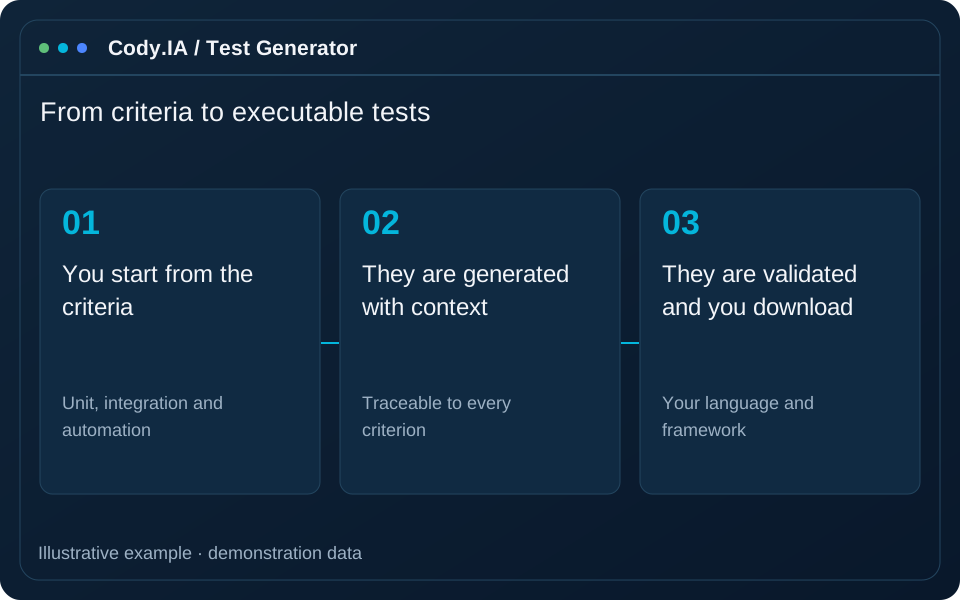
From criteria to executable tests
-
1
You start from the criteria
It uses the acceptance criteria Explorer generated for your project.
-
2
You choose the test type
Unit, integration or automation, depending on what you need.
-
3
They are generated with context
The AI uses the real structure of your code to write meaningful tests.
-
4
They are validated and you download
Each test is structurally validated and downloaded together with the others.
Structural validation does not prove a test passes or guarantee a coverage percentage. Execute the tests, review assertions and measure coverage in your project.
Tests with purpose
Three types of test
Unit, integration and automation for each criterion.
Full traceability
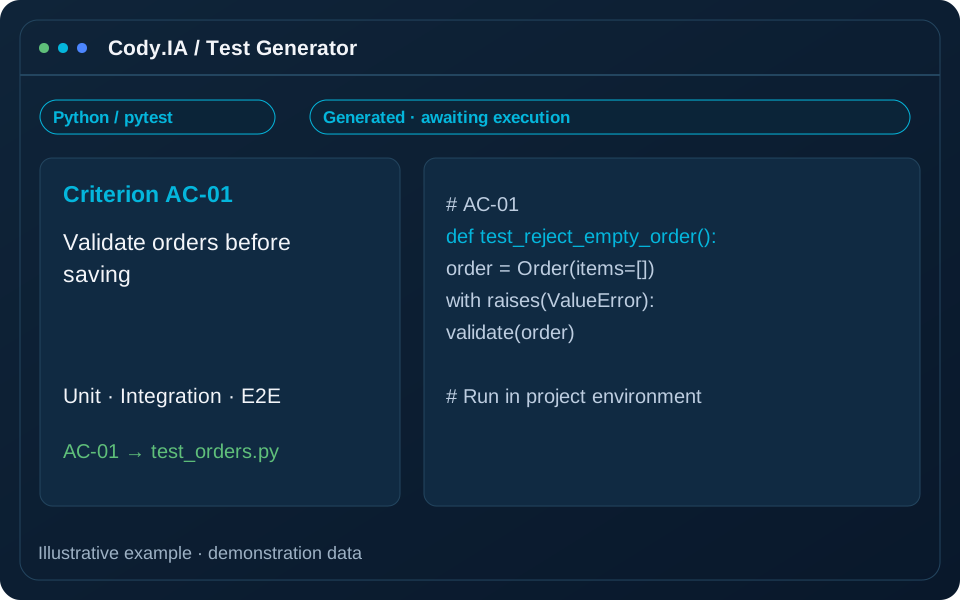
Each test references its source criterion: there are no orphan tests.
In your language
Generates in the language and with the framework of your project.
Given-When-Then cases
Clear scenarios and edge cases derived from the criteria.
Structural validation
Checks that each test is not empty and is idiomatic for the language.
ZIP download
Take the set of tests ready to add to your repository.
Who uses it
Coverage with judgment
Turn acceptance criteria into scenarios the team can review and run. Choose unit, integration or automation objectives and check that test data, assertions and edge cases represent business rules.
A safety net
Prepare a test baseline for refactors and functional changes. Configure the language and framework, review generated files and adapt fixtures, dependencies and mocks before adding them to the repository and pipeline.
Preserve behavior
Use existing system criteria to prepare regression tests for flows you plan to migrate. Run scenarios in the corresponding environments and compare results to investigate differences in behaviour.
Supported frameworks
These are the frameworks with their own templates; ask us about the one you use.
Verifiable quality
No orphan tests
Each test can be traced back to the criterion it validates.
Human review
Tests are generated for your team to review before adding them.
Your environment
The platform can run in your infrastructure.
Frequently asked questions
You may also like
Give your code a safety net
We generate tests for a real module of your system and you see how each one links to its criterion.